






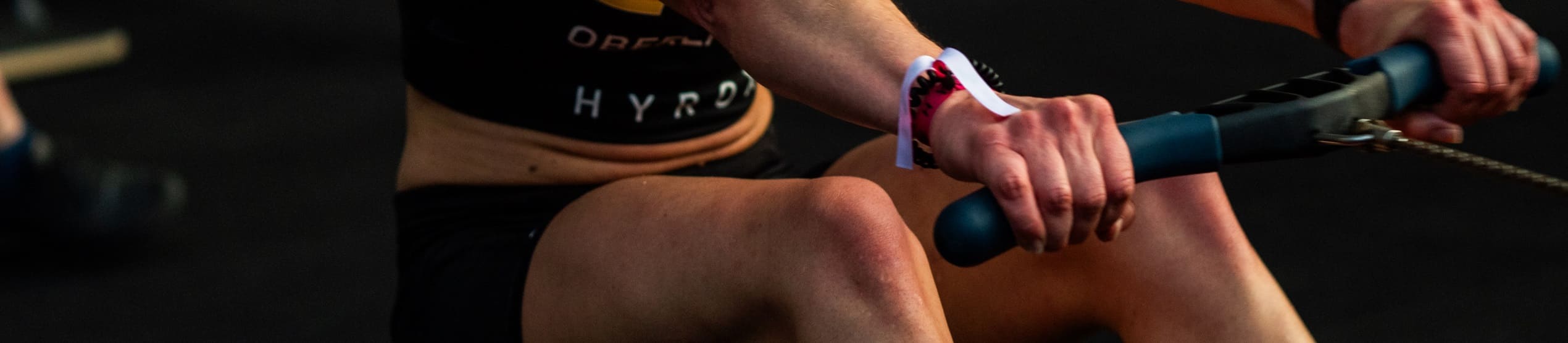
Hyrox Discipline #5 – RowErg
Requirements Profile

The RowErg is a crucial and often misunderstood element in the Hyrox competition. Although it is one of the workout stations, in terms of the load profile, it is more similar to running and has a highly aerobic and endurance-focused character. Crucial, as with running, is the knowledge of your anaerobic threshold – i.e., what pace you can maintain without accumulating an exponential amount of lactate. Just a few seconds too fast can cost you dearly in the subsequent run or the rest of the race.
As with the Skierg, the spread of times is relatively small. Between beginners and elite athletes, the difference is often only around 1 min, while in other disciplines (e.g., Sled Pull), differences of 5-10 min are not uncommon. Accordingly, it is less important to complete the best time than to row as efficiently and evenly as possible, so that you can go into the subsequent run at a high pace.
In addition, in this phase of the competition (Run 5 – Row – Run 6), the mental strength is particularly the deciding factor. After the demanding sled disciplines and Burpee Broad Jumps, the level of exertion is at a first peak for many athletes. At the same time, a large part of the race still lies ahead, which often has an additional demoralizing effect under exhaustion and carries the risk of losing the necessary bite and focus and relaxing too much on the RowErg and the following run. In this critical phase, it is time to prove your fighting spirit!
💡 This characteristic should also be considered in training. A solid aerobic base, precise knowledge of your thresholds, confidence in your own performance, good strength levels, and an efficient technique form the basis for a strong performance.
RowErg Technique
You can see the correct execution and tips on technique, training, and tactics here in the video by the first Hyrox World Champion Lukas Storath aka Luke.Fit.
A clean technique is crucial on the RowErg to save energy and achieve maximum performance. Here is a guide for optimal rowing technique:
1. Set-Up and Start (Catch)
Damper Setting: depending on the category, the air flap is preset to 5, 6, or 7. Choose a setting that corresponds to your strength level, body weight, and rowing technique. We generally recommend 4-6 for women and 5-7 for men. Under no circumstances should you set the air flap to 10; efficiency suffers enormously here – even rowing professionals with a body weight of 100kg+ never use this setting in competition!
Sitting position: Sit upright on the machine with a slightly forward-leaning upper body and extended arms. Keep the sternum slightly raised and make sure to sit on your sit bones, just by doing this your posture improves, which leads to better power transfer.
Build body tension: Before every pull, the core should be stabilized. A good pre-tension in the abdominal muscles and back ensures efficient power transfer.
2. Pull Phase (Drive and Finish)
Leg drive: Start the pull with a powerful use of the legs. Your legs should provide the majority of the pulling force – about 60-70%.
Hip opening: As soon as the legs are almost extended, open the hips powerfully and controllably and lean slightly back. Keep the back straight and the core activated.
Arm use: Finally, the arms pull the handle dynamically to the chest, about at the level of the lower sternum. The elbows should point backward and slightly sideways.
3. Return Phase (Recovery)
The return is done in exactly the reverse order: Start with the extension of the arms, followed by the forward movement of the core, and finally the loosening of the legs. Use this phase to breathe consciously, recover, and prepare for the next pull.
4. Rhythm
Very important: The crucial point lies in the correct switch between tension and dynamics in the pull phase and relaxation and rest in the return phase. Over the 1000m competition distance, you complete approx. 100-125 repetitions! Only if you perform the return without rushing and as a conscious mini-break can you maintain the power output and row efficiently!
Training for the RowErg
As stated in the requirements profile, it is not crucial for your Hyrox race to complete the fastest possible 1000m time, but rather to row in a controlled, energy-saving, yet brisk manner. To achieve this goal, the training on the rowing ergometer should take place predominantly in the technique and basic area for most athletes. These two training goals can also be optimally combined, e.g. in the form of stroke rate ladders (see info box in the next paragraph), where you vary the stroke rate, but keep the pace or heart rate constant. This way you not only train your aerobic capacity, but also develop a sense of rhythm, power application, and get a feel for the rowing ergometer – all extremely important components to perform as efficiently and energy-savingly as possible.
💪 Pro tip: Stroke rate ladder
To make your basic training more varied and at the same time complete an effective technique training, we recommend regularly playing with the stroke rate. On the RowErg display you will find your stroke rate (strokes/min). There are countless possibilities here for varied and challenging training sessions. An exemplary stroke rate ladder could look like this:
2-4 rounds (1 round = 14 min) with 2-3 min active rest (e.g. SkiErg or treadmill):
Each 2 min at 22, 24, 26, 28, 26, 24, 22 spm (strokes per minute = strokes/min) at constant speed or constant heart rate
Try to meet the requirements as precisely as possible. You will notice at the beginning how difficult it is to vary the stroke rate while maintaining the intensity. At a low stroke rate, you have to put correspondingly more power into each individual pull, the higher the stroke rate becomes, the easier each individual pull becomes (adjust damper setting if necessary).
With this exercise you not only train your aerobic base, but also your sense of rhythm and the correct movement sequence. In addition, over time you also develop a fine feel for consciously dosed power application and quickly find out which stroke rate feels the most natural and economical for you.

Unlike running, rowing is not very stressful for the joints and the overall system, which is why you can optimally complement your general endurance training here. Particularly effective are the Erg&Run sessions, e.g. 20 minutes Row, 30 minutes Run, 20 minutes Row. You can integrate these into your training plan almost as often as you want in various forms, as they put little stress and at the same time provide an excellent stimulus for the aerobic system. In addition, you train rowing technique and running-specific endurance – an ideal basis for your Hyrox performance!
Complementary you can increase anaerobic performance and power output through intense interval training (e.g. 10 x 300 m with 60 sec rest). Since Hyrox workouts are anyway mostly designed in the form of high-intensity interval training, you should use such additional HIIT sessions carefully and above all complete them in the off-season, if you have significant deficits in rowing.
In the immediate competition preparation, in addition to the essential basic training, you can use the RowErg above all as an intense pre-load in Hyrox-specific workouts. An effective example session:
5-10 rounds 500 m Row at high intensity, 25m Sled Pull, 400 m Run at competition pace, 60 – 120 sec jog or standing rest.
In addition to good technique and fitness, a well-developed maximum strength also helps you in rowing, which is why you can further increase your Row performance through strength training as well (depending on your starting level).
Alternative and complementary exercises
High strength levels in the legs and back and a solid body tension ensure the necessary "punch" and spare the cardiovascular system, therefore you should complete your training especially with strength deficits with some basic exercises. Even if you do not always have access to a rowing ergometer, the following alternatives are available, which train similar muscle groups and movement patterns:
Strength training: Deadlifts, Power Cleans and Squats promote the development of strength in the legs and core. Due to the high movement specificity, these exercises offer an excellent transfer: With a strong Deadlift and/or Power Clean in combination with good endurance values, you will be a very strong rower, even if you hardly train on the RowErg.
All horizontal pulling exercises (Barbell Rows, Croc Rows, Renegade Rows etc.) improve the ability to build important tension and promote the final pull impulse. In addition, they have a great importance for posture and back health, which should under no circumstances be neglected with the high and often one-sided Hyrox load!
Cardio alternatives: Assault Bike, SkiErg or exercise bike, to improve anaerobic capacity and quickly generate high lactate levels in Hyrox workouts and thus train the maintenance of performance under exhaustion.
Core stability: Planks, Russian Twists and Leg Raises strengthen the core, which is essential for rowing.
Tactics in the Hyrox competition
As already stated, it is crucial in rowing not to overpace. A few seconds gained on the RowErg can take their bitter revenge in the subsequent run or the rest of the competition. Here it is also important to differentiate according to performance requirements. For ambitious athletes, it can really come down to seconds in the fight for a podium place or the improvement of the personal best. If that is your goal, you must also stay "on the gas" in rowing, but always keep control. To do this, you should know your threshold value as accurately as possible. A good way to determine your competition pace is the following test:
💡 This is how you can determine your competition pace
Row 2000 m in a rested state for time. To the achieved average speed (in rowing always given in time/500 m), you add approx. 10 -12 sec to determine your competition pace. Example: If you need 4:10 min for the 2000 m, this corresponds to a pace of 2:05 min/500 m. Your competition speed should therefore be approx. 2:15 to 2:17 min/500 m. Of course, there can be individual deviations here, but you can determine a realistic target value in a simple way. You can repeat this test every 3-6 weeks and thus find your threshold value more and more accurately.
Beginners with less competition experience should keep some reserve. Due to the comparatively small spread of times, you will not win your race on the RowErg, but you can lose it at too high a pace. So pay special attention in your first Hyrox events to a controlled rhythm, calm breathing, and try to regulate the muscular fatigue and the heart rate after the hard stations beforehand. As soon as you feel strong and have the situation under control, you can slightly increase the pace, but you should never go beyond your threshold value.
💪 Pro tip:
Since the fan in the RowErg always lags by a few seconds, you can take a short break at the end. Complete the last pull at approx. 980 m with maximum strength, this is enough with the right timing to finish the distance and thus gives you valuable seconds of recovery without losing time.
⚠️ Attention: You may only leave the rowing machine when the distance counter stands at zero and the judge gives you the release. As long as you must hold the handle in your hand and may not yet release your feet. Make eye contact with your judge and as soon as you have the OK: Run!
RowErg in the Hyrox Double
In the Hyrox Double, the situation differs and accordingly the tactics differ significantly. While in the Hyrox Single rowing is a tightrope walk and can be mentally very demanding at this point, the station in the Double actually offers a possibility for recovery. For most Doubles, a single switch is advisable. This gives you approx. 2 min of complete recovery time with the same split, which represents an enormous relief at this critical point of the race. On a physical level, the heart rate regulates and lactate is broken down. In addition, you have enough time to take an Energy Gel or a Carbohydrate Drink with you, which gives you a noticeable energy boost for the rest of the race!
At least as important is the mental aspect: You can mentally divide the Hyrox race into 2 sections and with the knowledge of the longer break and the rewarding energy boost, the hard loads of the first half of the competition can be better endured.
The switch at the RowErg is more complex and involves a higher risk of error than at other stations, which is why for most Hyrox Doubles a single switch makes sense. Contrary to general belief, the switch is not necessarily associated with time loss. In advanced and very well coordinated athlete pairings, several switches can certainly be faster. Here, however, the processes must also be perfect under fatigue. In addition, the valuable longer break is lost, which is why this rowing tactic is only in question with very good fitness.
As with most other workout stations, the stronger runner should finish the rowing, so that you can switch directly to the running track at a high pace as a Double!
Conclusion
The RowErg in Hyrox is a discipline that demands technique, endurance, and mental strength equally. The right mix of efficiency and controlled intensity is crucial here, as overpacing can have serious consequences for the rest of the competition. A clean technique, a constant rhythm, and adhering to the individual competition pace help you to maximize your performance without wasting unnecessary energy.
A targeted training that takes into account both aerobic base and strength as well as competition-specific loads is the key to a strong RowErg performance.
With the right preparation and a clear plan, you can make the RowErg one of your strengths in the Hyrox competition – a station that saves you valuable seconds and secures an excellent starting position for the rest of the race!

